 Ventuals
Why You Can't Buy Private Company Stock (And What to Do Instead)
Private company stock is off-limits to most investors. Learn the three barriers — SEC rules, company gatekeeping, and illiquidity — and what you can do instead.
By Emily Hsia·Updated
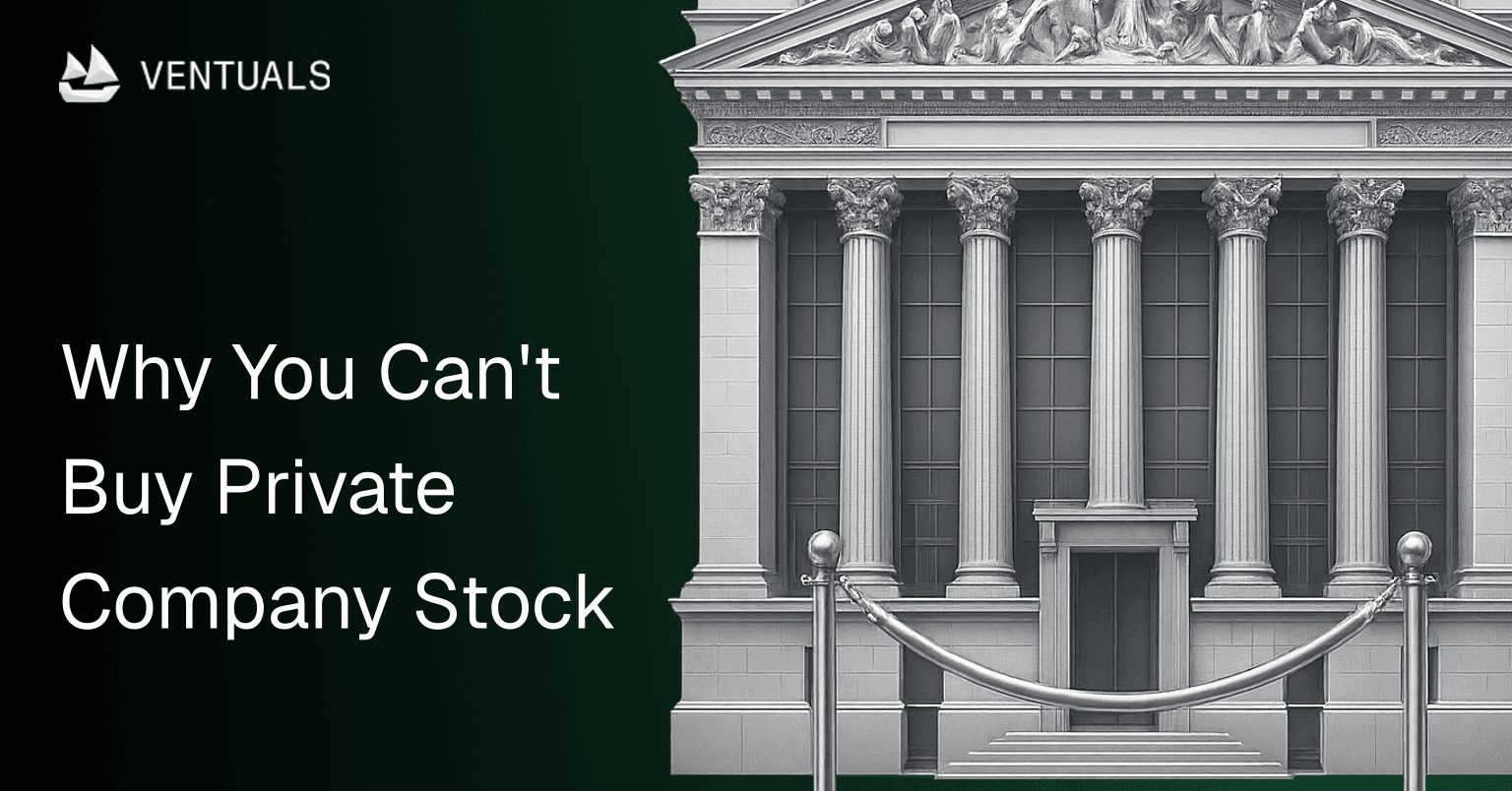
Most retail investors cannot buy private company stock. Unlike public shares that trade freely on exchanges like the NYSE or Nasdaq, private company stock is restricted by securities law, company-imposed rules, and structural barriers that effectively shut out anyone who is not wealthy, well-connected, or institutional.
Understanding why these barriers exist — not just that they exist — is the first step toward finding realistic alternatives.
The short answer
Private company stock does not trade on any public exchange. Most private offerings are conducted under SEC exemptions that limit participation to accredited investors — individuals who meet specific income or net worth thresholds. On top of that, private companies themselves tightly control who can appear on their cap table, often blocking transfers entirely. The result is a market that is, by design, closed to the vast majority of individual investors.
Three barriers between you and private company stock
1. SEC regulations and accredited investor rules
When a company raises capital without registering with the SEC — which is how nearly all private fundraising works — it relies on exemptions like Regulation D. These exemptions allow companies to skip the costly, time-consuming public registration process, but in exchange, they restrict who can invest.
The most common restriction is that buyers must be accredited investors. Under current SEC rules, that means an individual must have:
- Net worth above $1 million (excluding primary residence), or
- Annual income above $200,000 (or $300,000 jointly) for the past two years with a reasonable expectation of the same
The SEC's rationale is straightforward: private offerings come with less disclosure, less regulatory oversight, and higher risk than public securities. The accreditation requirement is meant to ensure that participants can absorb a total loss without financial distress. For a deeper look at how accreditation works and whether it still makes sense, see What Is an Accredited Investor?
The practical effect is that roughly 80-90% of U.S. households do not qualify. If you do not meet the thresholds, most private deals are legally off-limits to you — regardless of your knowledge, conviction, or willingness to accept the risk.
2. Company control over the cap table
Even if you are accredited, you still cannot simply buy private company stock the way you buy shares of Apple or Google. Private companies actively control who owns their shares.
Most private companies impose transfer restrictions in their bylaws and shareholder agreements. Common mechanisms include:
- Right of first refusal (ROFR) — the company or existing investors get the first opportunity to buy any shares before they can be sold to an outside party
- Board approval requirements — the company's board must approve any new shareholder
- Lock-up provisions — employees and early investors may be contractually barred from selling for years
There is also a regulatory incentive to keep the shareholder count low. Under Section 12(g) of the Securities Exchange Act, a company with more than 2,000 holders of record (or 500 non-accredited holders) triggers mandatory SEC reporting requirements — effectively forcing public-company-level disclosure. Most private companies work hard to stay below this threshold, which means they actively resist adding new, small shareholders.
The result: even in the secondary market, where existing shareholders sell to new buyers, the company itself acts as a gatekeeper. Companies like SpaceX and OpenAI are well-known for tightly controlling secondary transactions.
3. Structural illiquidity
Private company stock has no exchange, no order book, and no market maker. Buying and selling is a manual, negotiated process — closer to real estate than to stock trading.
In practice, this means:
- High minimums — secondary market transactions typically require $10,000 to $50,000 or more per deal
- Slow execution — a single transaction can take weeks to close, involving legal review, company approval, and transfer paperwork
- No price transparency — there is no live bid/ask spread; pricing is based on the last known funding round, broker estimates, or private negotiation
- No guaranteed exit — if you want to sell, you need to find a willing buyer, and the company has to approve the transfer
Even for investors who clear the accreditation and access hurdles, the illiquidity of private company stock makes it a fundamentally different experience from public-market investing.
Public stock vs. private company stock
| Public stock | Private company stock | |
|---|---|---|
| Where it trades | Public exchanges (NYSE, etc.) | No exchange — private negotiation |
| Who can buy | Anyone with a brokerage | Mostly accredited investors |
| Typical minimum | Price of one share | $10,000 - $50,000+ |
| Liquidity | Sell anytime during hours | Weeks to months, if at all |
| Price transparency | Real-time quotes | Sparse, often stale |
| Regulatory disclosure | Full SEC reporting | Limited or none |
What retail investors can do instead
The barriers above do not mean retail investors have zero options. The landscape has changed, and there are now a few ways to participate in private company value — even without accreditation or access to secondary markets. In fact, the case for investing in private companies has only gotten stronger as more value creation shifts to the pre-IPO phase.
Regulation Crowdfunding (Reg CF) allows non-accredited investors to invest in private companies through SEC-registered platforms. But in practice, the most sought-after private companies — the ones people are actually searching for — almost never raise through Reg CF. This path works better for early-stage startups than for companies like SpaceX or Anthropic.
Indirect exposure through public companies or funds is another option. Some public companies hold significant stakes in private companies, and some ETFs or funds offer thematic exposure. But the exposure is diluted and imprecise — you are not making a clean, single-company bet.
Price exposure through derivatives is the newest path. Platforms like Ventuals offer perpetual futures that track the implied valuation of specific private companies. You do not own the underlying shares, but your position moves with the company's market valuation. No accreditation is required, minimums can be as low as $10, and you can enter or exit at any time. For a deeper comparison of ownership vs. price exposure, see Owning Stock vs. Price Exposure for Private Companies.
For a full side-by-side breakdown of all three paths, see 3 Ways to Invest in Unicorn Startups as a Retail Investor.
FAQs
Why does the SEC restrict private company stock to accredited investors?
The SEC's framework assumes that private offerings carry higher risk and less disclosure than registered public securities. Accredited investor rules are designed to limit participation to individuals who can absorb a total loss without financial distress. Whether this is the best approach is debated — critics argue it locks out knowledgeable but less wealthy investors — but it remains the regulatory baseline.
Can I buy SpaceX or OpenAI stock before IPO?
Not directly, in most cases. Primary funding rounds at companies like SpaceX and OpenAI are reserved for institutional investors and well-connected insiders. Accredited investors can sometimes access shares through the secondary market, but minimums are high, fees are significant, and the companies themselves tightly restrict transfers. For non-accredited investors, price exposure through derivatives is the most direct way to participate in these companies' valuations before IPO.
What happens if I'm not an accredited investor?
You are excluded from most private offerings under Regulation D, which is how the majority of private fundraising works. Your main alternatives are Regulation Crowdfunding (limited to smaller companies), indirect exposure through public funds, or derivatives platforms that offer price exposure without requiring accreditation. See our full guide on how to invest in private companies for a breakdown of every path.
This article is for general informational purposes only and is not financial advice. It is not a recommendation or offer to buy, sell, or invest in any security, asset, or product. Always do your own research and consult qualified professional advisors before making investment decisions.
Read next
How to Invest in Private Companies: The 2026 Guide
Learn how to invest in private companies in 2026, including options for accredited investors, retail investors, and anyone seeking pre-IPO exposure.
Emily Hsia|Apr 13, 2026
What Is an Accredited Investor? (And Why You Don't Need to Be One Anymore)
An accredited investor meets SEC income or net worth thresholds to access private deals. Learn what qualifies you — and how to invest in private companies without it.
Emily Hsia|Apr 14, 2026
3 Ways to Invest in Unicorn Startups as a Retail Investor
Retail investors can participate in top startups through crowdfunding, ETFs, and derivatives. Compare all three paths — no accreditation required.
Emily Hsia|Apr 14, 2026
Two Ways to Invest in Private Companies: Ownership vs. Price Exposure
You don't have to be on the cap table to participate in a private company's upside. Learn the difference between stock ownership and price exposure.
Emily Hsia|Apr 14, 2026